
The Difference Between Reacting and Responding
Watch a little kid find something unfamiliar outside.
A caterpillar. A strange bug. A hole in the ground that absolutely needs to be poked with a stick.
There might be some hesitation. They may hang back for a second, look at you, then look back at whatever they have found.
But curiosity usually gets involved.
What is that? What happens if I get closer? Does it move? Can I touch it? Should I touch it?
(That last question may require adult supervision.)
Kids are remarkably good at moving toward something they don't completely understand because they want more information.
That's one of the differences between curiosity and reaction. Curiosity keeps looking. Reacting tries to close the question quickly.
Somewhere along the way, many of us get much better at doing the opposite.
Something unfamiliar happens, and we want an answer.
Immediately.
Uncertainty is uncomfortable
That makes sense, especially when the unfamiliar thing is happening in your own body.
You eat dinner and two hours later your belly is bloated. Your face starts flushing after a meal you have eaten plenty of times before. You wake up the next morning foggy and exhausted.
A food that was perfectly fine last Tuesday is apparently having opinions today.
Your brain wants to close the loop.
Was it dinner? The tomato? Histamine? The supplement you took that morning? Do you need to stop eating that now? Do you need to change something?
That urge to figure it out quickly is not unreasonable. When something feels threatening or unpredictable, not knowing can be uncomfortable all by itself.
Curiosity gives us another way to approach that uncertainty. It does not make the symptom disappear, and it does not require us to declare everything safe. It simply moves us toward gathering information before we decide what the information means.
Reacting tries to close the question
When I say reacting, I do not mean having a physical reaction.
I mean what happens next.
Something uncomfortable happens, and we move quickly from:
I had a reaction.
to:
That food caused it.
to:
I should stop eating that food.
Maybe that turns out to be exactly the right decision. Sometimes avoiding a food is necessary. Sometimes a reaction deserves medical evaluation. Sometimes your history has already given you plenty of information and there is no mystery to solve.
But sometimes we make a permanent rule from one piece of information because uncertainty feels worse than having an answer.
Even a shaky answer.
Reacting wants to close the question.
This happened because of that.
Done.
Except bodies rarely cooperate quite that neatly.
Responding leaves the question open a little longer
Responding creates some room between:
Something happened.
and:
I need to change everything.
That room is where curiosity gets useful.
Not cheerful curiosity. Not pretending you are delighted that dinner has become a science experiment.
More like:
Huh. That happened. What do I actually know?
You can still dislike the symptom. You can still be cautious. You can still decide not to eat the food again tomorrow.
Curiosity does not require you to override your instincts or prove anything. It simply keeps you from making the conclusion before you have looked at the clues.
Curiosity changes the questions
Reaction asks: What did I do wrong?
Curiosity asks: What happened?
Reaction asks: Which food do I need to remove?
Curiosity asks: What else was happening around this reaction?
Reaction asks: How do I make sure this never happens again?
Curiosity might ask: Have I seen this pattern before? What is different this time? What information would actually help me decide what to do next?
Those are very different questions.
And questions matter because they determine what we look for.
If you begin with Which food is guilty?, you are going to look for evidence against the food.
If you begin with What changed?, suddenly the field gets bigger. You start looking for what else might be contributing instead of immediately landing on the food.
This is where responding becomes a practice
My background is in science and education. One of the many things both have taught me is to be a bit methodical, to ask questions in a particular order, and to stay curious!
Step-by-not-very-glamorous-step:
Observe what actually happened. This is the data point, the information.
Sort what you know from what you suspect, fear, or have been told. Stay with what is actually happening, rather than what you are afraid might happen.
Connect the clues that seem to belong together. This can be the tricky part because we do not always know which clues matter yet. That is okay. You are looking for patterns, not trying to solve the whole case in one sitting.
Then respond. Not with the perfect decision. With a reasonable one.
Maybe you skip that food for a few days and see what happens. Maybe you eat it again in a different context. Maybe you realize the symptom started before dinner and the food suddenly looks a little less suspicious.
Maybe you recognize a pattern that deserves a conversation with your clinician.
Maybe you do absolutely nothing today except write it down.
That is still a response.
The point is not to become your own doctor. It's to become a better observer of your own story and a steadier participant in the decisions that follow.
Responding does not mean ignoring danger
Curiosity has limits.
If you have symptoms that could represent a serious allergic reaction or another medical emergency, this is not the moment to sit quietly with a notebook wondering what else was happening Tuesday. Please get appropriate care.
Responding also does not mean forcing yourself to eat something that feels unsafe just to prove you are not afraid.
The goal is not fearlessness.
The goal is having more than fear available when you make the decision.
There is room for caution. There is room for uncertainty. And there can also be room for curiosity.
Maybe we knew something as kids
Kids ask a ridiculous number of questions.
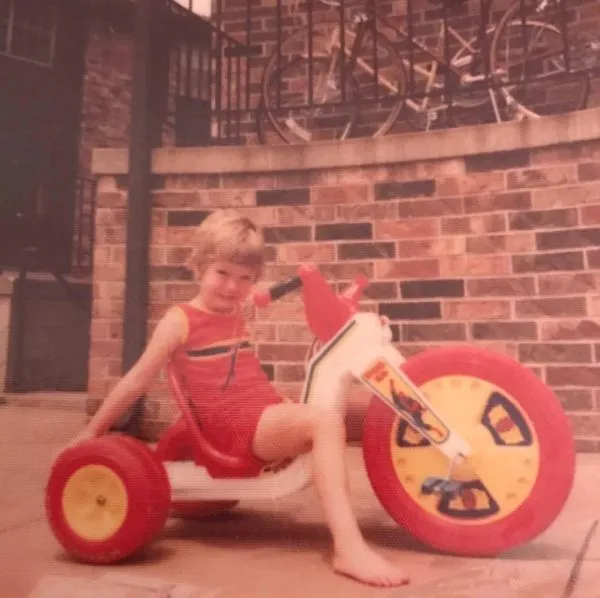
Why? What is that? What happens if...? How does it work? Can I see? Or my four-year-old self's favorite - whasat?
We spend years teaching them not to lick shopping carts and climb bookcases, so some editing of childhood curiosity is probably useful.
But I wonder if we sometimes edit out too much.
Somewhere along the way, uncertainty starts feeling like something we are supposed to eliminate rather than investigate.
Especially when it comes to our bodies.
We want to know. We want the clean answer. We want the safe-food list to stay put. We would very much like Thursday's body to follow Tuesday's instructions.
And sometimes it simply does not.
Responding begins by staying with the question long enough to learn something before deciding what it means.
Curioser and curioser.
Maybe that is a skill worth getting back.
60-Second Self-Care
Try the Curiosity Pivot
The next time something feels off, give yourself one minute before deciding what it means.
Ask three questions:
What happened?
Describe only what you actually observed.
What else was true?
Name one or two pieces of context. Think beyond the food. What else was happening?
What do I need to decide right now?
Maybe something. Maybe nothing.
You don't have to solve the whole reaction in one minute.
You are creating enough room to respond instead of automatically reaching for the first explanation.
Sometimes that small bit of room is where the useful information finally shows up.


